Munishwaran — The Village Guardian God of South India

Munishwaran (also known as Muneeswarar, Muniyandi, Muniyappan, and Muni Ayya) is one of the most widely worshipped village guardian deities (Kaval Deivam) in Tamil Nadu and across the Tamil-speaking world. From the rural heartlands of South India to the urban streets of Chennai, Singapore, and Malaysia, Munishwaran stands as a powerful protector who watches over families, villages, and travellers alike.
Unlike the major deities enshrined within grand temple complexes, Munishwaran is most often worshipped in open spaces, beneath sacred trees, at village borders, and along roadsides. His presence is felt in the everyday life of devotees—protecting them from danger, injustice, accidents, and negative forces. His worship is deeply personal, passed from elders to children through stories, rituals, and lived experience.
This complete guide explores the origins, forms, worship practices, festivals, and diaspora traditions of Munishwaran, offering a comprehensive understanding of why this guardian deity continues to hold a central place in the hearts of millions.
Store passwords, IDs, documents and private information securely on your phone. No cloud. No tracking.
Who Is Munishwaran?
Munishwaran (Tamil: முனீஸ்வரன், lit. "Sage-like Lord") is a Tamil folk deity popular in northern Tamil Nadu and across South India. The name is a combination of "Muni" (sage or saint) and "Ishvara" (lord or ruler), an epithet traditionally associated with Lord Shiva. This etymological connection reflects his identity as a guardian deity who embodies the protective and ascetic qualities of Shiva himself.
He is worshipped as a family deity (Kula Deivam), a guardian deity (Kaval Deivam), and a favourite deity (Ishta Deivam) by millions of devotees. He is also recognised as a divine attendant to the major South Indian folk goddess Mariamman, serving as her protector and messenger.
Unlike gods worshipped mainly inside big temples, Munishwaran is often worshipped in open places—at village borders, under sacred trees, and along roadsides—showing that his duty is to watch and protect at all times. His worship began in animist times, usually under trees, and has continued unbroken for generations.
His presence gives a feeling of safety and discipline to the community. He is believed to guard the village boundaries, especially during the night, ensuring that wrongdoers think twice before harming others.
Names and Forms of Munishwaran
Munishwaran is known by many names across Tamil Nadu and the Tamil diaspora. Each name reflects a different aspect of his divine personality and regional tradition:
- Muneeswarar — the most common Sanskritized form, meaning "Lord of Sages"
- Muniyandi — a familiar Tamil name used in rural devotional songs
- Muniyappan — meaning "Father Muni," expressing affectionate devotion
- Muni Ayya and Ayya — respectful terms meaning "Lord"
- Muniswaran — the popular spelling used in Tamil Nadu and Malaysia
- Munishwaran — the form commonly used in Sri Lanka and Singapore
- Muniyappa, Munusamy, Muniyamma — names given to children as a mark of devotion
There are many versions of this deity popular in different parts of Tamil Nadu. Some traditions worship him as a single stone with sacred markings, while others depict him as three stones representing his threefold protective power. In some shrines, he is worshipped in the form of a rock, brick, lamp, or even a simple wooden staff.
Origins and Historical Roots
The exact origins of Munishwaran are complex and layered, drawing from multiple streams of Tamil religious history. Understanding these roots helps us appreciate the depth and resilience of his worship.
The Buddhist Monk Connection
One historical theory traces the origin of Munishwaran to the Buddhist monks of ancient Tamil country. In Tamil, "Muni" refers to the braided and coiled hair worn by sages and nomads, and "Ishwar" means "lord." During the period of Buddhist influence in Tondai Nadu (northeastern Tamil Nadu), farmers who followed Buddhism began calling their monks "Munishwarans."
When the Pallava kings rose to power and Shaivism became the dominant royal religion, these Buddhist monks were gradually replaced as village guardian deities by the fierce, protective forms of Shiva's attendants. The name "Munishwaran" remained, but its meaning shifted from the peaceful Buddhist monk to the warrior-like guardian deity we know today.
The Shiva Gana Tradition
According to another tradition, Muniandi is believed to be a member of Shiva's retinue (Gana). He is one of the seven emanations created from Shiva's face, who promised to guard Mariamman and other Dravidian goddesses. This connects Munishwaran directly to the Shaiva tradition, where he is seen as a manifestation of Shiva's protective energy.
The Vayu Purana does not mention the Munis worshipped today as Muniswaran or Muniandi in connection with Daksha's Sacrifice. This confirms that the Munis worshipped today have their own independent origin, separate from the mainstream Puranic narrative, and likely emerged from the ancient guardian-spirit traditions of the Tamil country.
Heroes and Sages Elevated to Divinity
Some Muni deities have historical origins. They could be former warriors, kings, or sages who achieved the status of a Muni after their human death. These individuals, known for their valour, justice, or spiritual power, were elevated to divine status by their communities and continue to be worshipped as guardians.
Other Munis were never human—they were created as Munis by divine will and did not go through the human life cycle. These include the Saptha Muni (seven sages) who are believed to guard the directions and protect the boundaries of sacred spaces.
Different forms of Muni exist across Tamil Nadu. Ratha Muni is identified as a stronger deity, generally associated with saving the village or the farms that surround it. Kotai Muni is depicted with soldier figurines who protect the town or the fort of rulers, portrayed as men carrying long swords and round shields.
Depiction and Iconography
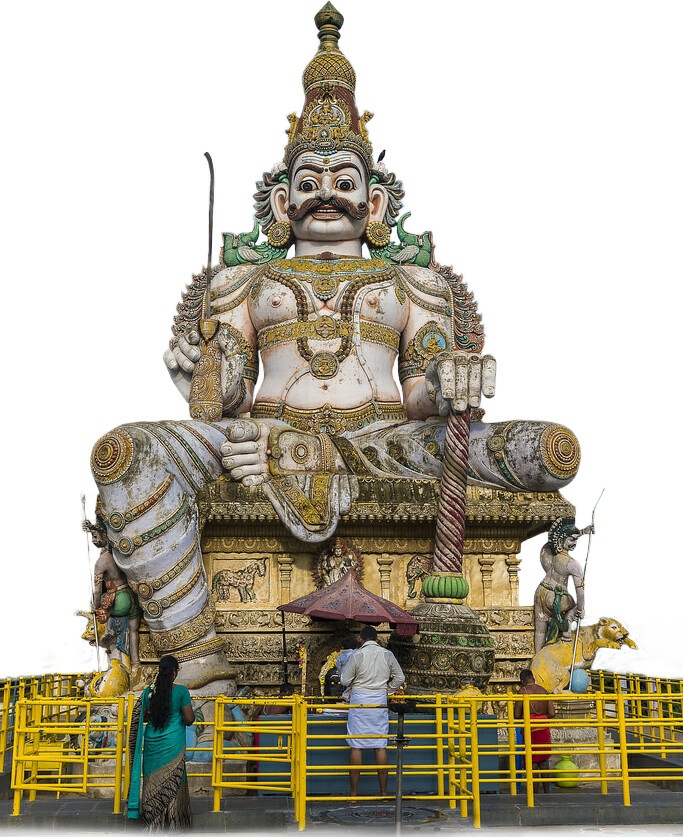
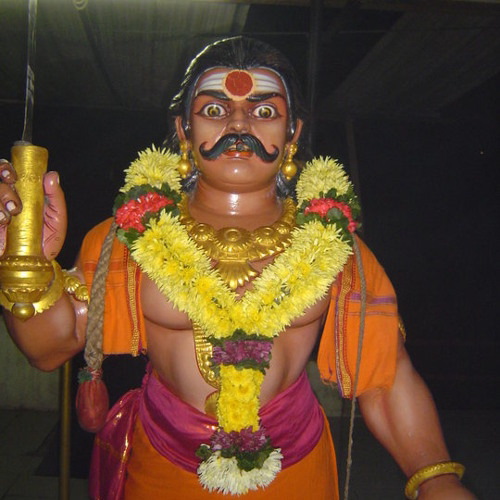
Munishwaran is typically depicted as a powerful, muscular male deity in the prime of life. His fierce appearance is not meant to frighten devotees but to signal his readiness to protect them from evil forces.
Physical Appearance
He is portrayed wearing a large moustache, with a furrowed brow, bulging reddened eyes, teeth bared in a grimace, and protruding canines. His fierce countenance is part of his protective function—frightening away evil spirits and wrongdoers who would harm his devotees.
His forehead and body are believed to be smeared with holy ash (vibhuti), a clear indication of his association with Lord Shiva. This ash serves as a reminder of his divine origin and his connection to the Shaiva tradition.
Weapons and Attributes
Munishwaran is usually depicted wielding one or more of the following weapons:
- Trishula (trident) — the primary weapon of Shiva, symbolising the threefold power of creation, preservation, and destruction
- Aruval (sickle) — a symbol of his role as a guardian who cuts down evil and injustice
- Gada (mace) — representing strength and authority
- Spear and sword — symbols of his warrior nature
- Whip — used to drive away evil spirits
In many depictions, Munishwaran has one foot resting upon a demon's decapitated head, symbolising his victory over the forces of chaos and evil. This iconography reinforces his role as a protector who actively confronts and defeats negative forces.
Mount and Companions
Munishwaran's traditional mount is the horse. Every night, astride his horse and accompanied by his guard, he is believed to patrol his jurisdiction, defending his territory's integrity and securing its order. In some traditions, he is accompanied by other minor deities and animals such as bulls, horses, or dogs, which are believed to be his vehicles or companions.
Forms of Worship
Munishwaran is worshipped in several forms, each with its own significance:
- Tree Worship (Maram Vazhipadu) — the oldest form, where he is believed to reside in sacred trees such as Banyan (Ala Maram), Sacred Fig (Arasa Maram), and Palmyra (Pana Maram). These trees are considered gateways between dimensions.
- Stone Worship (Nadukkal Vazhipadu) — a single stone or three stones decorated with sacred ash, sandal paste, and saffron paste, with a trident planted as a mark of Shiva and Shakthi.
- Statue Worship — the most contemporary form, where statues of granite, metal, or clay are erected and decorated to help devotees visualise the deity.
- Formless Worship — in some shrines, he is worshipped without any physical form, as a lamp, a brick, or simply as a presence in an open space.
The Role of Munishwaran as a Village Guardian
In olden days, villages did not have police stations or modern security systems. People depended on faith and discipline to maintain order. Munishwaran was believed to be the divine force that guarded the village boundaries, especially during the night.
Villagers believed that wrongdoers would think twice before harming others because Munishwaran was always watching. This belief helped people live honestly and peacefully. His shrine at the village border served as both a spiritual and social institution, reinforcing community ethics and collective security.
The minis—amoral fertility spirits that inhabit the territories protected by Munishwaran—are kept in check by his presence. These spirits are believed to cause diseases, blights, and crop failures when angered, but Munishwaran's protective power prevents them from harming the community. Every five years, lineages enact a worship culminating in sacrificing roosters and goats to Munishwaran, renewing the covenant between the deity and his people.
Munishwaran is also recognised as a divine attendant to Mariamman, the major South Indian folk goddess. In this role, he serves as her guardian and messenger, ensuring that her worship is conducted properly and her devotees are protected.

Store passwords, IDs, documents and private information securely on your phone. No cloud. No tracking.
Why People Respect and Fear Munishwaran
Munishwaran is respected as well as feared. This fear is not meant to harm people. It teaches important values like:
- Speaking the truth — honesty is the foundation of a disciplined life
- Keeping promises — a vow made before Munishwaran is considered sacred
- Avoiding cheating and injustice — wrongdoers are believed to face swift consequences
People believe that if they pray to Munishwaran with a false heart, it may bring consequences. Because of this belief, many devotees try to live a disciplined and truthful life. The fear of divine retribution serves as a powerful social regulator, encouraging ethical behaviour even when no human authority is watching.
Munishwaran's exacting expectations of caste and ritual rectitude, combined with immediate retaliation of lapses and inordinate anger, are key characteristics that distinguish him from other similar village tutelary deities. His devotees know that he demands sincerity and integrity, not elaborate rituals performed without true devotion.
Simple Worship Practices
Worship of Munishwaran is usually simple and sincere. Common practices include:
- Visiting the shrine on Tuesdays, Fridays, and Saturdays — the days traditionally associated with Munishwaran
- Visiting on Sundays and during Aadi month Fridays for special observances
- Lighting oil lamps — a simple act of devotion that dispels darkness
- Offering flowers, coconuts, and bananas — traditional offerings of purity and sweetness
- Breaking coconuts — symbolising the breaking of the ego
- Praying silently with honest intentions — the most important offering
- Offering camphor, sandalwood paste, and incense — for purification and devotion
- Preparing Pongal (ritual rice) as a communal offering
People believe Munishwaran responds quickly when prayers are made with truth and respect. The simplicity of the worship reflects the accessible nature of the deity—no elaborate priesthood or expensive rituals are required, only a sincere heart.
Vegetarian and Non-Vegetarian Traditions
Munishwaran is worshipped in both orthodox Vedic ways and non-Vedic ways. In Agamic temples, prayers and rituals are conducted in Sanskrit by Brahmins, and only vegetarian food products are offered to the deity. In such temples, Munishwaran is venerated as a "higher" deity and treated as Shiva himself.
In non-Agamic temples and village shrines, worship is less rigid. This form sometimes involves animal sacrifices, offerings of non-vegetarian food items, alcohol, and tobacco. This style of worship can be found in non-Agamic temples, roadside shrines, and homes.
Some shrines serve Munishwaran with vegetarian offerings as a sattvic form of Shiva, while others receive fierce worship with animal sacrifice and offerings of liquor and cheroots, according to the custom of the place. Despite these differences, all devotees share the same deep faith in his protective power.
Temple Festivals and Rituals
Munishwaran temples across Tamil Nadu hold vibrant festivals that bring communities together in devotion and celebration. These festivals are marked by ancient rituals that have been passed down through generations.
Kumbabishegam (Consecration Ceremony)
Many Munishwaran temples hold grand consecration ceremonies called Kumbabishegam, during which the deity's power is renewed and the temple is spiritually recharged. This is followed by Nithya Poojai (daily worship) and annual festivals that maintain the temple's sanctity.
Annual Festivals
Annual festivals at Munishwaran temples typically include:
- Kappu Kattuthal — the ceremonial tying of protective threads, marking the beginning of the festival
- Abhishegam and Deeparadhanai — bathing the deity and offering lamps
- Poo Charithal — flower procession, where devotees carry flowers to the deity
- Pookuzhi Vizha — fire-walking festival, where devotees walk across burning embers to fulfil vows
- Kavadi and Paal Kudam — carrying decorated poles and pots of milk as offerings
- Thiruvilakku Poojai — special worship with sacred lamps
- Annadhanam — community feeding, where all devotees share a meal together
Worship festivals for Munishwaran involve procession, vow-offerings, and possession rites through which the god delivers oracles. During these festivals, the deity's power is believed to descend upon chosen devotees, who speak his words and offer guidance to the community.
Special Days
Certain days are considered especially auspicious for Munishwaran worship:
- Tuesdays, Fridays, and Saturdays — weekly days of worship
- Ammavasai (New Moon) — a powerful day for offerings
- Chitra Pournami — the full moon day in the Tamil month of Chithirai
- Aadi month Fridays — special days for preparing Pongal and tonsure offerings
- Panguni Uthiram — a sacred full moon festival

Bodyguard Muniswaran of Chennai
One of the most famous and unique Munishwaran temples is the Arulmigu Om Sri Bodyguard Muneeswaran Temple at Pallavan Salai in Chennai, located just a few metres from the Central Railway Station. This shrine has a distinct identity—it is dedicated to the "Guardian of Motorists," and thousands of devotees bring their new vehicles here for blessings.
The Ritual of Vehicle Blessing
The ritual is simple but deeply symbolic. Devotees place their vehicle keys at the deity's feet, camphor is lit, and a coconut is broken. Priests perform Aarathi—with a coconut bearing a lit camphor on top—in front of the vehicle to ward off the evil eye. Then lemons are kept under the tyres, and the owner runs over them. A black thread (thirusti kayiru) and a garland are tied to the number plate, and sandal paste is smeared on the vehicle.
This age-old practice is believed to safeguard the driver and vehicle from accidents. Devotees can also purchase custom-made evil eye protectors, camphors, flowers, country cigars, and camphor to offer the deity.
Origins of the Name
The temple's unusual name has multiple origin stories. One version recalls a time when the area was poorly lit and considered unsafe. Locals tell of an old man with a cigar who would mysteriously appear to escort travellers through the dark lanes, believed by some to be Muneeswaran himself.
Another theory traces the name to colonial times, when British officers' bodyguards were stationed nearby. A popular legend holds that in 1919 CE, labourers from the North Arcot district brought a Muniswaran idol and placed it under a neem tree adjoining the military barracks. A British troop commander objected to this and met with an accident the same day. Since then, people started believing in the power of the deity to protect from accidents.
Some believe the deity was brought from Padi, where the armed forces of the Pallavas and Cholas were stationed. Thus, "Padikaattu Muniswaran" became "Bodyguard Muniswaran." The bus drivers from the Central Bus Depot would also stop and pray every time a bus left and entered the depot. Whenever a new bus was rolled out, they made sure the puja was performed on it.
The temple also houses Munishwaran's consort Kateri Amman and the Saptha Kannigal (Seven Virgins). Sundays, Ammavasai, and Chitra Pournami are special days for performing rituals. For the past 162 years, the same family has served as the temple's trustees and license holders to perform the puja.
Munishwaran in the Tamil Diaspora
Munishwaran's cult travelled abroad with Tamil migrants, and today he is worshipped in countries such as Malaysia, Singapore, Indonesia, Fiji, and Sri Lanka. The deity, brought from Tamil Nadu to Malaya more than 170 years ago, has developed a powerful appeal for young Singaporean Hindus three and four generations removed from their Indian origins.
Malaysia and Singapore
Most Munishwaran temples in Malaysia and Singapore were initially set up by immigrants who came from Tamil Nadu, particularly from Thanjavur, Thiruvarur, and Nagapattinam districts. These early Tamil migrants brought their family deities with them, and the worship of Munishwaran became a central part of their religious life in the new land.
In the 1970s and 1980s, thousands of Tamil Hindus from West Malaysia moved to Singapore to work and stay. They shared the worship of deities like Muneeswaran, helping to strengthen that area of Tamil Hinduism that was being threatened by the move to public housing flats. The strong presence and veneration of this male deity on the island, and the innovative styles of religiosity now associated with him, justify calling Muneeswaran a "new god" in the Indian diaspora.
Burma and Sri Lanka
The cult also travelled to Burma, Malaya, Singapore, and Ceylon. The labourers were the ones who formed the bulk of Munishwaran's core devotees. When they moved back to India, they returned with Munishwaran—by way of bringing soil from the land which they had considered their home. Munishwaran was transplanted to India by incorporating the soil brought from abroad in the clay used to make a fresh idol here.
The Aathu Muniswaran Temple on the banks of the Adyar River in Chennai is one such example. The Burma Colony in Nandambakkam came up in the 1960s, and the Muniswaran was put up shortly thereafter. The giant clay idol, at least two storeys in height, dominates the temple, and flood markings on the idol itself speak to its long history.
Today, the worship of Munishwaran in the diaspora is not merely a nostalgic connection to the past. It is a living, evolving tradition that continues to attract new generations of devotees, adapting to urban life while preserving its ancient roots.
Belief Passed Through Generations
The worship of Munishwaran is not written in books for many people. It is passed from elders to children through stories and experience. Even today, many villagers first pray to Munishwaran before starting important work or travel.
This oral tradition is not a weakness but a strength. It means that the worship of Munishwaran is deeply personal and lived, not merely learned. Each generation adds its own experiences and insights to the collective understanding of the deity, keeping the tradition alive and relevant.
In many families, Munishwaran is the Kula Deivam—the ancestral protector who watches over the family lineage. Children are taught from a young age to respect and pray to him, and the stories of his protection are recounted during family gatherings and festivals. Names like Muniyappa, Munusamy, and Muniyamma are given to children as a mark of devotion, ensuring that the deity's memory is carried forward.
This shows how deep the belief is and how strongly it is connected to everyday life. Munishwaran is not a distant deity to be worshipped only on special occasions—he is a constant presence in the lives of his devotees, guiding, protecting, and disciplining them as needed.
Moral Lesson from Munishwaran Worship
People believe that Munishwaran does not protect those who do wrong. He protects those who live honestly and respect others. Many devotees say that when they speak the truth and keep their promises, they feel less fear in life.
Munishwaran reminds us that faith and right actions must go together. When our heart is clean and our actions are good, divine protection follows naturally. The worship of Munishwaran is not about appeasing an angry god with offerings; it is about aligning our lives with the principles of truth, discipline, and respect that he embodies.
In a world where ethical behaviour is often seen as optional, Munishwaran stands as a powerful reminder that integrity matters. His presence at the village border is not just about physical protection—it is about protecting the moral fabric of the community. When people know that a divine guardian is watching, they are more likely to act with honesty and fairness.
Frequently Asked Questions About Munishwaran
Who is Munishwaran?
Munishwaran (also known as Muneeswarar, Muniyandi, and Muniyappan) is a village guardian god worshipped in many parts of South India, especially Tamil Nadu. His name combines "Muni" (sage) and "Ishvara" (lord), and he is considered a form of Lord Shiva. Devotees believe he stands at the village borders and protects people from danger, injustice, and negative forces.
Why is Munishwaran worshipped in open places?
Unlike gods worshipped mainly inside enclosed temples, Munishwaran is often worshipped in open places—at village borders, under sacred trees, and along roadsides. This reflects his traditional role as a guardian who watches over the community at all times, especially at village boundaries. His worship began in animist times, usually under trees, and this practice continues today.
What values does Munishwaran worship teach?
Munishwaran worship traditionally teaches important values such as speaking the truth, keeping promises, and avoiding cheating and injustice. Many devotees believe that praying with a false heart may bring consequences, which encourages them to live a disciplined and truthful life. The fear of divine retribution serves as a powerful social regulator, encouraging ethical behaviour.
How do people worship Munishwaran?
Worship of Munishwaran is usually simple and sincere. Common practices include visiting the shrine on Tuesdays, Fridays, and Saturdays, lighting oil lamps, offering flowers and coconuts, breaking coconuts, and praying silently with honest intentions. Some shrines also offer Pongal as a communal offering. The simplicity of the worship reflects the accessible nature of the deity.
Is Munishwaran worship written in scriptures?
For many communities, Munishwaran worship is not written in books. It is passed from elders to children through stories and lived experience. The Vayu Purana does not mention the Munis worshipped today as Muniswaran or Muniandi in connection with Daksha's Sacrifice, confirming that this deity has his own independent origin. Even today, many villagers first pray to Munishwaran before starting important work or travel.
What is the main moral lesson from Munishwaran worship?
The central lesson is that faith and right actions must go together. Munishwaran is believed to protect those who live honestly and respect others. When our heart is clean and our actions are good, divine protection follows naturally. The worship of Munishwaran is about aligning our lives with the principles of truth, discipline, and respect.
What are the weapons of Munishwaran?
Munishwaran is usually depicted wielding a trishula (trident), aruval (sickle), gada (mace), spear, sword, and whip. In many depictions, he has one foot resting upon a demon's decapitated head, symbolising his victory over the forces of chaos and evil. His traditional mount is the horse, and he is believed to patrol his jurisdiction every night.
What is the significance of Bodyguard Muniswaran in Chennai?
The Bodyguard Muniswaran Temple in Chennai is famous as the "Guardian of Motorists." Thousands of devotees bring their new vehicles here for blessings, performing rituals like placing keys at the deity's feet, breaking coconuts, and tying protective threads. The temple's name has multiple origin stories, including a colonial-era connection and a legend of a mysterious old man who escorted travellers through dark lanes.
How is Munishwaran worshipped in the Tamil diaspora?
Munishwaran is worshipped in countries such as Malaysia, Singapore, Indonesia, Fiji, and Sri Lanka. The deity was brought from Tamil Nadu to Malaya more than 170 years ago by Tamil migrants, and his worship has developed a powerful appeal for young Singaporean Hindus. In the diaspora, Munishwaran temples serve as centres of Tamil cultural and religious identity, maintaining traditions that remain village-based in India.
Conclusion — The Silent Protector of Village Life
For devotees, Munishwaran is not just a god at the village border. He is a silent protector who watches over daily life. People feel his presence when they travel safely, when problems reduce, and when justice slowly comes in their favor.
Worship of Munishwaran is about living with discipline, honesty, and respect. That is why even today, many people trust Munishwaran and continue to pray with deep belief and faith. From the rural heartlands of Tamil Nadu to the bustling streets of Chennai, Singapore, and Malaysia, his presence is felt by millions who seek his protection and guidance.
Whether you are a devotee seeking his blessings, a student of Tamil religious traditions, or simply curious about this powerful guardian deity, the story of Munishwaran offers profound lessons about faith, integrity, and the enduring power of community. May his protective presence watch over you and your loved ones always.
Store passwords, IDs, documents and private information securely on your phone. No cloud. No tracking.
Related Devotional Posts
You may also like our other devotional collections on village deities and traditional worship.
Disclaimer
The content published in this post, including descriptions of Munishwaran worship, traditional beliefs, and devotional explanations, is shared solely for devotional, educational, and informational purposes. The information is based on traditional beliefs and commonly available spiritual references.
While every effort is made to present the content respectfully and accurately, the author does not claim absolute correctness, completeness, or guaranteed outcomes. This content must not be considered professional advice, including medical, psychological, legal, financial, astrological, or religious guidance.
Spiritual beliefs and personal experiences may vary between communities and individuals. Readers are advised to use their own judgment and discretion. If any information provided here is inaccurate or objectionable, kindly contact us for correction or removal.




Comments
Post a Comment