Jada Muni is not merely a guardian deity. He is a timeless protector, an ascetic sage, and a powerful spiritual force rooted in ancient Dravidian belief systems.

Revered as one of the most significant manifestations of Muneeswarar, Jada Muni represents the perfect balance between Lord Shiva’s deep ascetic wisdom and his fierce, uncompromising protective power.
In the modern spiritual landscape of 2026, the worship of Jada Muni has expanded far beyond village borders.
Today, he is worshipped across Tamil Nadu, Sri Lanka, Malaysia, Singapore, and by the global Tamil diaspora, offering protection, stability, and ancestral grounding in an increasingly complex world.
Store passwords, IDs, documents and private information securely on your phone. No cloud. No tracking.
Meaning and Core Identity of Jada Muni
The name Jada Muni itself reveals his spiritual essence.
The word Jada, meaning matted hair, symbolizes the containment of immense spiritual energy. In Shaiva and yogic traditions, matted hair represents mastery over desires and control over elemental forces.
Jada Muni’s jada is believed to govern forests, water sources, land fertility, and the natural balance of the environment.
The word Muni refers to an enlightened sage who attains wisdom through silence (Mouna) and intense penance (Tapas).
Jada Muni is not a mere warrior guardian. He is a guarding sage—one who protects not only the physical body of the devotee but also the mind and soul.
Unlike deities who react only to visible threats, Jada Muni is believed to identify the hidden root of suffering and neutralize it before harm manifests.

Mythological Origins of Jada Muni
The origins of Jada Muni are understood through three interwoven traditions: Puranic belief, Tamil folk history, and esoteric Shaiva practice.
Shaiva Puranic Tradition
According to Shaiva lore, Jada Muni emerged during the cosmic episode of the Daksha Yajna. When Sati immolated herself after being insulted by her father Daksha, Lord Shiva entered a state of divine fury and performed the destructive Tandava.
From Shiva’s sweat and matted hair arose powerful beings. While Virabhadra embodied destruction, Jada Muni manifested as the force that preserved balance.
He protected innocent beings, sacred spaces, forests, and natural life during the chaos, ensuring that destruction did not consume creation entirely.
Tamil Folk Tradition
In Tamil oral traditions, especially around Madurai, Thanjavur, and surrounding regions, Jada Muni is remembered as an ancient forest dwelling ascetic or tribal guardian king.
Legends describe him as a protector of villages who defended people from wild animals, thieves, and unseen dark forces.
After his passing, his presence was believed to remain so powerful that villagers began worshipping him under neem or banyan trees.
Over generations, this hero worship merged with Shaiva theology, transforming Jada Muni into a revered incarnation of Muneeswarar.

Esoteric Shaiva Tradition
An esoteric belief describes Jada Muni performing penance while standing on one foot above the surface of a pond for thousands of years.
This form of water penance symbolizes mastery over emotions, karma, and worldly suffering.
Water represents the cooling of inner turmoil, and through this tapas, Jada Muni is believed to have gained the power to calm intense karmic disturbances in the lives of devotees.
Jada Muni Among the Saptha Munis
Jada Muni is one among the Saptha Munis, the seven sacred Munis who collectively govern different aspects of spiritual and worldly protection.
Each Muni holds a distinct role, and Jada Muni’s unique domain is protection from black magic, negative energies, and imbalance in nature.
He is especially invoked when devotees feel affected by unseen forces or spiritual disturbances.
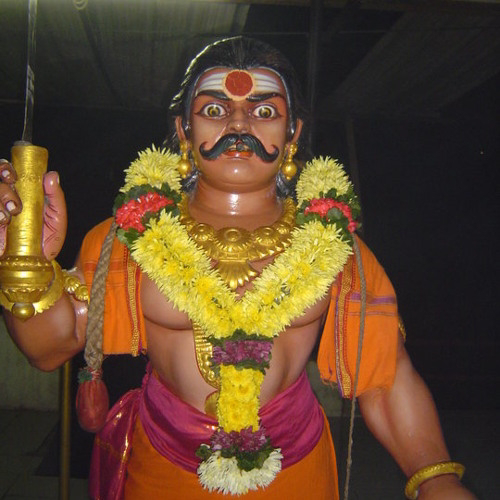
Iconography and Symbolism
The form of Jada Muni is rich with symbolic meaning.
His thick mustache represents fearless authority and guardian strength. The trident in his hand signifies mastery over the three gunas, Sattva, Rajas, and Tamas.

The aruval, or curved blade, symbolizes the cutting away of ego, illusion, and negative influences.
Sacred ash covering his body reminds devotees of the impermanence of material life.
He is often depicted with a white horse, symbolizing his readiness to rush into the lives of devotees to protect them without delay.
Jada Muni is one among the Saptha Munis, the seven sacred guardian sages.
• Maha Muni – Prosperity and spiritual enlightenment
• Shiva Muni – Removal of sins and karmic burdens
• Thava Muni – Mastery over mind and deep penance
• Dharma Muni – Justice, law and righteous living
• Naadha Muni – Music, speech and divine sound
• Vaal Muni – Physical protection and warrior strength
• Jada Muni – Protection from black magic and unseen forces
Rituals and Worship Practices
The worship of Jada Muni uniquely bridges classical Shaiva temple rituals and ancient folk traditions.
In Agamic temples, he is worshipped with milk, honey, sandalwood paste, and sweet offerings such as pongal. These rituals emphasize purity, balance, and spiritual harmony.
In village shrines, offerings may include cigars, alcohol, or meat.
These are not acts of indulgence but symbolic representations of worldly burdens that Jada Muni absorbs to protect his devotees from harm.
Jada Muneeswarar Homam
The Jada Muneeswarar Homam is a powerful fire ritual performed during extreme personal, financial, or spiritual difficulties.
This homam is believed to remove planetary afflictions, shield devotees from negative energies, and restore stability.
It involves sacred woods, herbs, and mantras offered into the fire under strict ritual discipline.
Mantras for Daily Devotion
Chanting Jada Muni mantras during the early morning hours is believed to strengthen spiritual protection.
Moola Mantra
Om Shreem Hreem Kleem Jadama Magudatharaaya
Ugra Veeraaya Sarva Shatru Naasanaaya
Jada Muniswaraaya Namaha
This mantra is believed to create a protective spiritual shield against jealousy and harmful energies.
Gayatri Mantra
Om Jadhaatarayaa Vidmahe
Khadga Hasthaaya Dhimahi
Thanno Jada Muni Prachodayaath
This mantra is chanted for mental clarity and decisive strength.
Famous Temples Associated with Jada Muni
Among the most revered shrines is the Bodyguard Muneeswarar Temple, where devotees seek lifelong vehicle protection.

The Jalan Baru Sri Muniswarar Temple stands as a powerful symbol of Tamil diaspora faith, famous for intense trance rituals.
The Sri Muniswarar Maritime Temple highlights Jada Muni’s role as a protector of travelers and those working in dangerous professions.
Relevance of Jada Muni in the Modern Era
In today’s world, Jada Muni represents grounded strength and silent vigilance. As a guardian of nature, his worship resonates with eco-spiritual values.
As a fierce protector, he offers psychological and spiritual resilience in times of stress.
For younger generations, Jada Muni serves as a bridge to ancestral roots, reminding them of their Kula Deivam traditions in a rapidly globalized society.
Jada Muni stands as the unseen guardian at the threshold of human life.
Whether worshipped as a village protector beneath a sacred tree or as a divine Shaiva guardian in temples across the world, his essence remains unchanged.
He is protection without noise, power without arrogance, and vigilance without rest.
To invoke Jada Muni is to align oneself with a spiritual force that has safeguarded generations across centuries.
Related Posts
Saptha Munigal & 21 Parivara Munigal
Daily Mantra – Simple Devotional Mantras for Daily
Chanting
Support Our Devotional Journey
This devotional space is created to share sacred
mantras, divine stories, and spiritual knowledge
with pure devotion and sincerity. All content is
offered freely to help devotees find peace, faith,
and inner strength through spirituality.
If you feel spiritually connected or benefited by
our devotional posts, you may choose to support this
journey. Your support encourages us to continue
sharing meaningful devotional content for
everyone.
This devotional space is created to share sacred mantras, divine stories, and spiritual knowledge with pure devotion and sincerity. All content is offered freely to help devotees find peace, faith, and inner strength through spirituality.
If you feel spiritually connected or benefited by our devotional posts, you may choose to support this journey. Your support encourages us to continue sharing meaningful devotional content for everyone.
DISCLAIMER
The content published in this post, including mantras, meanings, benefits, and spiritual explanations, is shared solely for devotional, educational, and informational purposes. The information is based on traditional beliefs, commonly available spiritual references, and AI assisted content generation.
While every effort is made to present the content respectfully and accurately, the author does not claim absolute correctness or completeness of the information. This content does not guarantee any specific results and must not be considered professional advice, including medical, psychological, legal, financial, or astrological advice.
The author and publisher shall not be held responsible or liable for any direct, indirect, incidental, or consequential outcomes arising from the reading, interpretation, or practice of the content shared here.
Spiritual outcomes and personal experiences may vary based on individual faith, intention, discipline, and belief. Readers are advised to apply their own judgment and discretion while following any devotional or spiritual practice.
By accessing or using this content, you acknowledge and agree that you are solely responsible for your interpretations, actions, and decisions.




Comments
Post a Comment